+91-9355000192
 Login

Conversational AI for Customer Experience: Use Cases, Benefits, and Examples
- What Is Conversational AI for Customer Experience?
- How Conversational AI Works
- Voice AI in Customer Service
- Core Technologies Behind Conversational AI
- 6 Practical Uses of Conversational AI for Customer Experience
- Conversational AI for Customer Experience Across Industries
- Benefits of AI for Customer Experience
- Why Businesses Choose Gupshup
- Conclusion
See the power of intelligent conversations for your brand.

You: I want to cancel my subscription.
Bot: Sure! Are you looking to subscribe to a new plan?
You: No, I want to cancel.
Bot: Please select an option: 1. Upgrade plan, 2. Get help with billing.
Soon, frustration sets in as you realize the bot doesn’t understand you. You type “Speak to an agent,” and the bot replies, “Let me help you with that!” The loop continues. Conversational AI for customer experience fixes this. Instead of following rigid scripts, conversational AI understands what customers mean, resolves their issues in natural conversation, and hands them to a human agent with full context when needed, on WhatsApp, voice, web chat, and other channels, 24/7.
In fact, customers expect this level of service. According to Meta’s State of Business Messaging report, based on a 2025 Kantar survey across 22 markets, 72.4% of consumers are more likely to buy from brands that offer messaging, and 67.7% find AI chatbot replies helpful. At the same time, Gartner predicts that by 2029, agentic AI will autonomously resolve 80% of common customer service issues.
In this guide, you’ll learn what conversational AI for customer experience is, the technology behind it, practical use cases across industries, and how businesses use it to create standout service. For a deeper dive, read our conversational AI guide.
What Is Conversational AI for Customer Experience?
Conversational AI for customer experience is the use of AI agents, chatbots, and voice assistants that understand natural language to make every customer interaction faster, more personal, and easier. It understands customer intent, answers questions, completes tasks like bookings and refunds, and hands complex issues to human agents across chat, voice, and messaging apps.
How Conversational AI Works
Conversational AI enables machines to talk with people in natural, human-like language. In practice, it powers chatbots, AI agents, and voice assistants that understand questions, give accurate answers, and keep conversations flowing.
It combines natural language processing (NLP), machine learning, and large language models (LLMs). As a result, it automates repetitive questions, gives instant and accurate replies, and frees human agents to handle complex issues.
Meanwhile, messaging apps have become central to how people reach brands. That’s why WhatsApp, Instagram, and web chat are now essential customer service channels. Gupshup helps businesses bring AI to all these channels through one platform, so customers get a consistent experience wherever they reach out.
For businesses, this shift also means lower costs, because AI handles routine work. In addition, AI scales easily, so service quality stays consistent even as conversation volumes grow.
Voice AI in Customer Service
Voice AI is changing phone support, too. Gupshup’s Voice agent combines calls, chat, and text in one interface. For example, call-to-messaging deflection moves callers to the WhatsApp API or SMS, which reduces handling times and call-backs.
In addition, virtual numbers improve call pick-up rates and protect privacy with number masking. A unified contact center lets teams work remotely, transfer calls, and automate resolutions with multi-level IVR menus during peak hours. Meanwhile, automatic call transcription and real-time performance tracking help agents improve. With 12 million daily calls, 99.99% uptime, and over 1 million virtual numbers, Gupshup helps businesses scale voice support reliably.
Voice AI offers three key benefits:
- Hands-free support: first, customers get information and services just by speaking.
- Better accessibility: in addition, voice helps people with disabilities and those who prefer talking over typing.
- Personalized interactions: finally, AI uses customer data to tailor every response.
Core Technologies Behind Conversational AI
Several technologies work together to power conversational AI across marketing, commerce, and support.
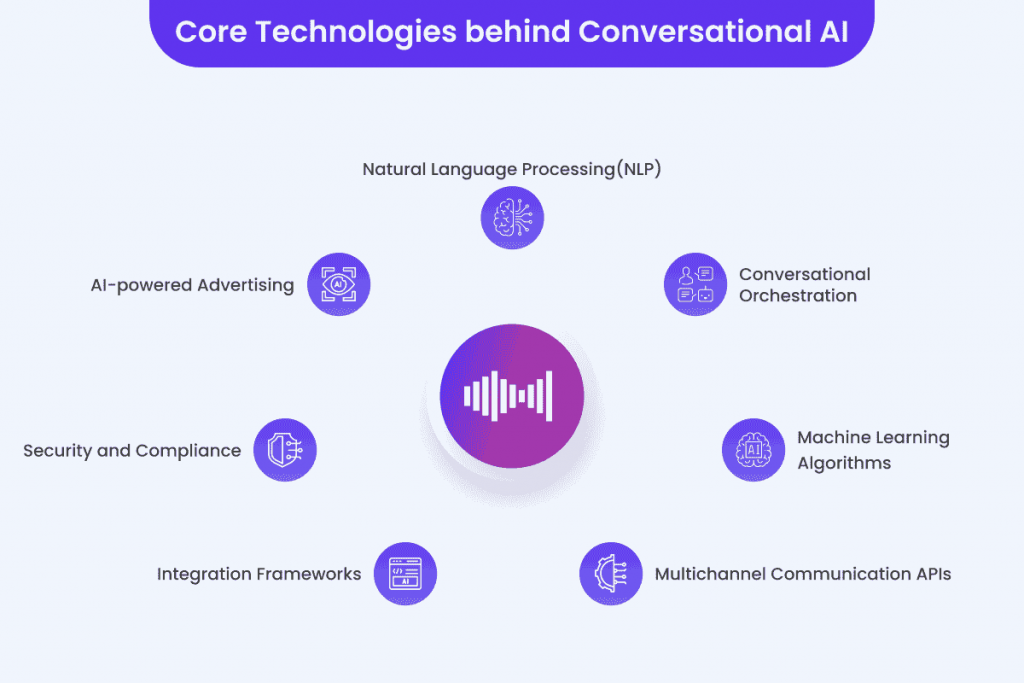
1. Natural Language Processing (NLP)
First, NLP lets machines understand and generate human language. Through steps like parsing, sentiment analysis, and language generation, it understands text and replies with precision.
2. Conversation Orchestration
Next, workflow builders and journey orchestration tools automate conversation flows, personalize replies, and ensure smooth handovers between AI and live agents.
3. Machine Learning
In addition, machine learning helps systems improve over time. By learning from past interactions, it makes replies more accurate and personal.
4. Multichannel Messaging APIs
Similarly, APIs deliver consistent messages across WhatsApp, RCS, SMS, and voice. Built-in failover keeps messages flowing even if one channel fails.
5. Integrations
Beyond that, AI connects with CRMs, e-commerce platforms, and marketing tools. For instance, Gupshup integrates with Shopify, WooCommerce, and Magento for a unified experience.
6. Security and Compliance
Of course, conversational AI must follow data privacy rules like GDPR and industry regulations. Therefore, strong security measures protect sensitive customer data in every conversation.
7. AI-Powered Advertising
Finally, click to WhatsApp ads and other interactive ads open a direct chat with the brand. AI agents then qualify leads and hand hot prospects to sales.
6 Practical Uses of Conversational AI for Customer Experience
Here’s how businesses use conversational AI in customer service.
Handle FAQs and Reduce Workload
AI agents answer repetitive questions and deflect tickets, which eases the load on support teams. Because NLP understands questions phrased in different ways, AI agents work well on websites and messaging apps. Gupshup’s AI agents automate FAQs, support multiple languages, and route complex queries to human agents.
Understand Customers and Build Loyalty
In addition, AI analyzes customer behavior to personalize service at every step of the journey. As a result, businesses strengthen relationships, improve retention, and increase lifetime value.
Speed Up Responses
Voice and chat assistants solve common issues instantly, without waiting for an agent. Consequently, response times drop, and CSAT scores rise.
Support Multiple Languages
Conversational AI understands chats, emails, and calls in many languages while keeping the original tone and intent. So, global audiences get smooth, natural support.
Spot Trends and Patterns
Similarly, AI analyzes large volumes of conversations to uncover trends, such as common complaints or rising demand. This helps businesses predict customer needs and improve their strategies faster.
Protect Customer Data
Finally, security tools detect unusual behavior, flag threats, and automate protective actions. Therefore, customer data stays safe, and teams save time.
Conversational AI for Customer Experience Across Industries
Conversational AI improves customer interactions in every industry. Here are four examples.
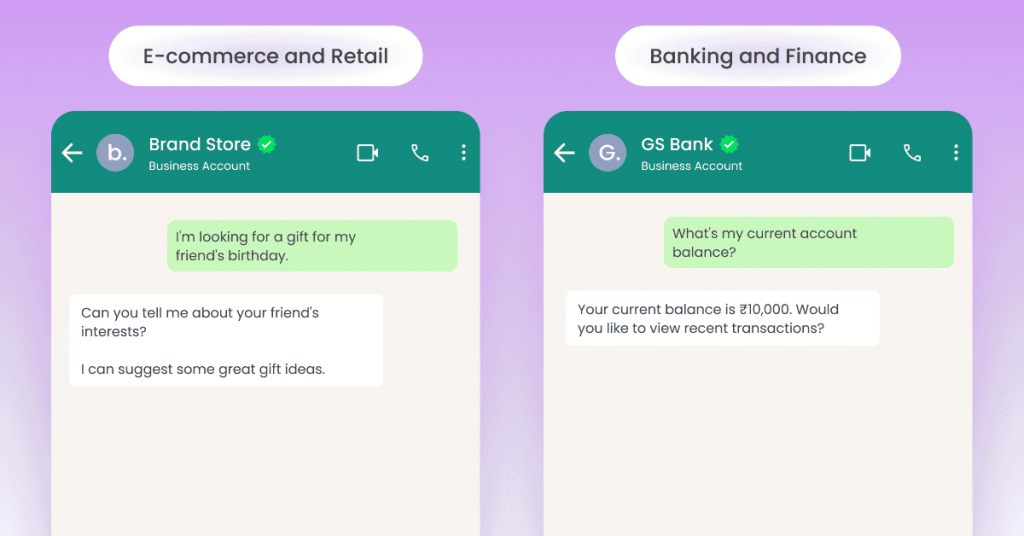
Retail
First, AI agents offer personalized product recommendations and real-time support based on preferences and purchase history. For example, Gupshup’s AI-powered shopping assistant helped a retailer increase quarterly sales.
Banking and Financial Services
In financial services, AI agents help with transactions, account management, card blocking, and insurance claim questions. As a result, banks and insurers stay responsive around the clock.
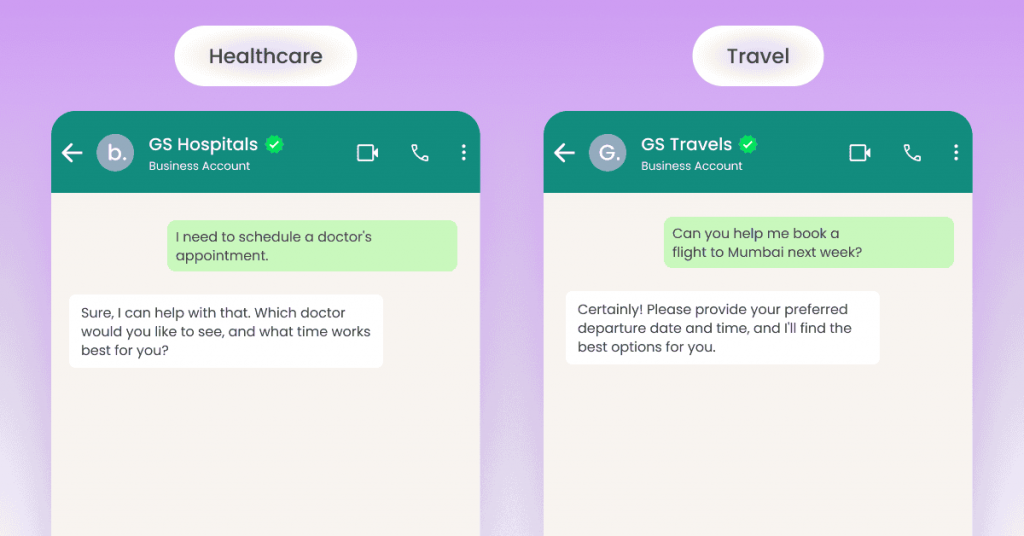
Healthcare
Conversational AI in healthcare helps patients book appointments, get basic information, and receive medication reminders. This improves patient care and reduces front-desk workload.
Travel
In the travel industry, AI agents help customers book flights and hotels, change itineraries, and get real-time updates on delays or cancellations.
Benefits of AI for Customer Experience
Here’s what businesses gain:
- 24/7 availability: customers get help at any time, even outside business hours.
- Scalability: AI handles high conversation volumes during peak times without lowering quality.
- Lower costs: as a result, automating routine tasks reduces the need for large support teams.
- Better engagement: personalized conversations build stronger relationships.
- Consistency and accuracy: AI gives the same accurate answers every time, which builds trust.
- Data-driven insights: conversation data reveals customer needs and helps improve service.
Gupshup’s Conversation Cloud brings all these benefits together in one platform.
Case Study: Axis Bank’s Aha! AI Assistant
For example, Axis Bank partnered with Gupshup to launch Aha!, an AI-powered assistant for fast, accurate, and personal banking services. As a result, customers can use Aha! for fund transfers, card blocking, bill payments, and general questions.
Key results:
- Engagement: handled over 20 million customer queries with 97% accuracy.
- Scale: grew its user base 40X.
- Recognition: won the DX Leader Award at the IDC Digital Transformation Awards 2018.
Why Businesses Choose Gupshup
- Complete platform: AI agents, voice bots, and analytics work together across WhatsApp, Instagram, RCS, SMS, voice, and web.
- Fast deployment: in addition, a no-code bot builder helps teams design and launch AI experiences quickly.
- Omnichannel reach: customers get a consistent experience on every messaging app they use.
- Proven scale: case studies like Axis Bank show Gupshup’s ability to handle millions of conversations.
Conclusion
Conversational AI for customer experience helps businesses deliver personal, context-aware service that makes customers feel understood. It offers instant, consistent, 24/7 support, automates routine tasks, and lets human agents focus on complex issues. In addition, conversation data helps teams keep improving.
Ready to transform your customer experience with AI? Book a demo today.
FAQs
What is conversational AI for customer experience?
Conversational AI for customer experience uses AI agents, chatbots, and voice assistants that understand natural language to make customer interactions faster and more personal. It understands intent, resolves issues, completes tasks, and hands complex cases to human agents across chat, voice, and messaging apps.
What are examples of AI in customer experience?
Examples include WhatsApp AI agents that track orders and process returns, voice bots that handle calls, banking assistants that block cards, and travel bots that rebook flights.
How is AI transforming customer engagement?
AI gives instant, personalized responses, automates routine tasks, offers 24/7 support, and uses data to predict customer needs, which improves efficiency and satisfaction.
What is the difference between a chatbot and conversational AI?
A basic chatbot follows fixed scripts and menus. Conversational AI, on the other hand, understands natural language and context, so it can handle varied questions, complete multi-step tasks, and hand over to humans smoothly.

Divya is a multifaceted writer and a journalism graduate. A wordsmith by profession and passion, she crafts compelling narratives as a seasoned content writer while also weaving poetic tapestries in her leisure moments. Whether delving into informational prose or evocative verse, her love for the written word brings finesse to every piece she pens down.